Mevlana Museum and Whirling Dervishes – Konya Travel Guide
Table of Contents
The Mevlana Museum is located in the heart of Konya, which is one of the important cities of south central Anatolia. It is some 260 kilometers from Ankara and 440 kilometers southeast of Istanbul. Konya is usually not featured in the Turkey travel itinerary of many first-timers. This is indeed a shame, as Konya is the most religiously conservative big city in Turkey. Without knowing that fact, you will lose out on much of what is going on around you.
Millions of visitors every year
Mevlana Museum receives more than 2.5 million visitors every year, making it one of the most popular museums in Turkey. It is estimated that most of its guests are domestic pilgrims, not tourists. That ratio will change everything about your perception of the place once you step inside.
Who Was Mevlana Rumi? And What Is Special About Konya?
Jalal ad-Din Muhammad Rumi was born on September 30, 1207, in Balkh in present-day Afghanistan. The Rumi family moved due to constant threats from the Mongols. The family moved west and stopped in Konya, which was one of the largest Seljuk cities, because Rumi’s father received an invitation to work at a madrasa(University) there. At the age of about 24, Rumi settled there and spent all the rest of his life.
For the first two decades in Konya, Rumi was a respected Islamic theologian and scholar, but everything changed dramatically in 1244. It was on November 15 that he met Shams-i Tabrizi, a traveling Sufi dervish. This meeting was extremely powerful; therefore, Rumi decided to leave everything else behind and have philosophical dialogues with his new friend for many days in a row. Rumi’s students and family members did not like this idea, but the poet did not care.
The Birth of Masnavi
It is said that Shams-i Tabrizi disappeared after two years in 1248. According to some versions, he was murdered by the jealous friends of Rumi, according to others, he left Rumi to preserve their relationship forever. However, Rumi tried to find him everywhere, including Damascus, and then devoted himself entirely to creating poetry. Two collections of his poems have become masterpieces of world literature – Masnavi, consisting of six volumes in Persian, and Divan-e Shams-e Tabrizi with over 3,000 pieces written in honor of his lost love.
Rumi died on December 17, 1273, in Konya. His grave was enclosed the next year by order of his successor Husamaddin Celebi, who erected a mausoleum over it. The turquoise dome of Mevlana Mausoleum, where Rumi was buried, can still be seen today.
What Is the Mevlana Museum?
The official name of the complex is the Mevlana Muzesi. This means that Mevlana’s shrine, the old dervish lodge, a library, a mosque, and even the museum itself are contained within the walls at Mevlana Caddesi No. 1 in the Karatay area of Konya.
Mevlevi Sufi Order, which was founded based on the teachings of Rumi, and its leader Rumi’s son; Sultan Walad, established a spiritual center at this site nearly seven centuries ago. But Ataturk closed down all Sufi orders as part of a secularization process in 1925. The following April, a decision was made to turn this complex into a museum. It opened to the public on March 2, 1926.
An often-mistaken assumption about museums is that they are institutions where one can see the historical artifacts. But this is not always true because Mevlana Shrine Museum is also a place for active pilgrimage. You will notice people crying near the tomb, whispering prayers. The transformation of a shrine into a museum has been done on the legal side but not spiritually.
Beyond the Tomb – Things to See in Konya
Visitors to the mausoleum usually enter the premises, make their way to the tomb chamber, stop in front of the sarcophagus in the green dome, take some pictures there and leave the complex without looking at anything else around. And yet there is much more to it than meets the eye.
For a start, visitors come here mainly to admire the Kubbe-i Hadra, which covers the tomb of Rumi and is called the Green Dome because it is made of turquoise-glazed tiles. This has been Konya’s main landmark for over 750 years, and below this dome rests the sarcophagus covered with a velvet shroud, surrounded by the tombs of Rumi’s father, family and followers who were buried here over the following centuries.
One of the structures that visitors pass without paying much attention to is the Semahane, the ceremonial hall, which was constructed by Suleiman the Magnificent in the 16th century. Here, for several centuries, until 1926, the Sema ceremony was held. Today, the building is a museum, and the instruments used during the ceremony can be seen here. These are kemence, rebab, kudum drums, and the ney (reed flute). However, for the followers of the Mevlevi Sufism, ney is not just a musical instrument. This musical instrument is theologically important, since it was used as an allegory for the soul longing for God at the beginning of Rumi’s Masnavi.
There is also a glass case with a box that supposedly holds several strands of the Prophet Muhammad’s beard. According to the museum, it is considered the holy relic of Mevlana. But, as visitors pass through here, they usually fail to notice this fact because it is indicated by a small placard in the case.
Kitchen with Mannequins
The old dervish kitchen or Matbah is located in the southwestern part of the premises. It was constructed by Sultan Murat II in 1548, and in the context of the Mevlevi Order, it was an institution that served multiple purposes: for preparing meals, as well as training novice dervishes for 1,001 days. The interior decoration is modest and simple, and only the structure itself indicates the importance of this place.
Usually, when I bring my tourists to the complex, I take them to visit the kitchen first. In that case, people enter the tomb chamber somewhat calmer. The kitchen changes your perception of what this complex used to represent.
1,700 Handwritten Books
The library contains 1,700 handwritten books, among which there are several manuscripts written by Rumi himself. Here, for example, is kept the Divan-e Shams-e Tabrizi dating from 1366-1368. You wouldn’t be able to see all the manuscripts of course. However, selected ones are kept in the reading room. You may even find a 9th-century gazelle-skin Christian manuscript in the Semahane.
Semahane and Whirling Ceremony
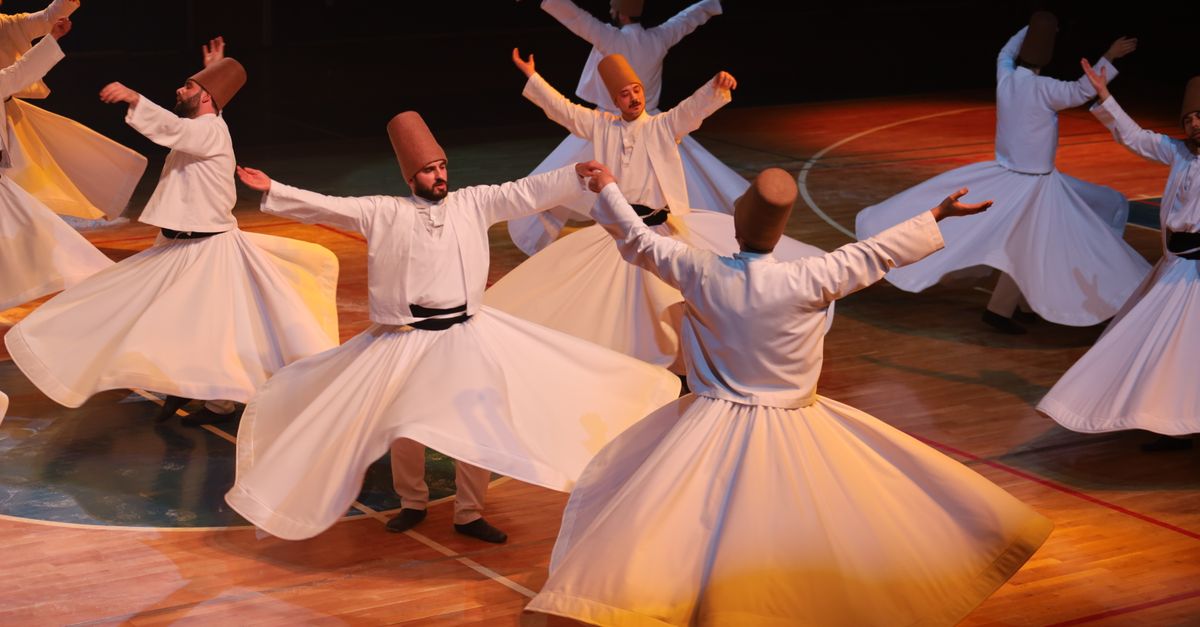
It is important to know whether it is a dance or a prayer ritual because you should watch it from that point of view.
This practice was developed as an interpretation of Sufism by members of the Mevlevi Order. Dervishes perform it wearing a white cloak called a kirpan, a tall hat called a sikke, and a black cape. The black cape is taken off at the beginning of the ceremony. It symbolises liberation from the material world. The white cloak symbolises the shroud of the dead person buried by his loved ones. Spinning reflects the rotation of planets or particles. The dervish turns to God. He raises his right hand with open palms to catch the blessings of the Almighty, while the other hand turned down is supposed to spread these blessings upon the Earth.
The Whirling Dervishes’ Sema Ceremony was inscribed in the UNESCO Representative List of the Intangible Cultural Heritage of Humanity in 2008.
Note that the ceremony is performed entirely in Turkish and Arabic without subtitles. Thus, it makes a great difference whether you have learned something about its structure before going there or not. Having only an elementary idea about the process will make you understand everything that happens during the first twenty minutes.
Another date when it is worth coming to Konya is December 17 – the Night of Union (Seb-i Arus) when Rumi died and according to the Mevlevi tradition united with the Almighty. This ten-day celebration attracts thousands of pilgrims from all over Turkey and the rest of the Islamic world.
When To Visit Konya?
Konya lies on the Anatolian plateau, at an altitude of approximately 1,000 m. The summers are hot and dry, winters cold and snowy. The most pleasant time to enjoy the walkings in Konya is spring and autumn.
Saturday seems a great choice for seeing Sema, but if you want to experience Konya in full cultural and spiritual sense, the best period to visit will be the dates 7-17 of December – a period named Seb-i Arus. Bear in mind that at the times of such festival the town becomes overcrowded, so hotels fill long ago. In order to come to Konya during the Seb-i Arus festival, it is wise to arrange everything well before November.
The museum is the least crowded in the morning hours on weekdays before 11 AM. If you happen to visit just in opening time, there are places in the complex which will be left to you. Starting from midday hours, especially in summer time, tourist buses come in and make a lot of people appear.
Getting to Konya
Hire A Car in Konya
A car is not necessary but becomes useful for inland routes.


There are high speed YHT train connections from Istanbul, via Eskisehir. They take about 4.5 to 5 hours approximately. Trains reach Konya Selcuklu HST Station, which is near to the tramway route and the central part of the town. Tickets are bought on the internet portal of TCDD.
Eight trains connect Konya and Ankara daily. These connections last 260 km and take not more than 2 hours. Thus, it is quite convenient to get to Konya even in one day from Ankara, although spending some night here, especially if you want to visit the Sema on Saturday, would be much better.
Most probably you will have to use a bus to reach Konya from Cappadocia. The journey lasts about 3.5 to 4 hours through Aksaray. Such combination of visiting both places is quite popular for travelers coming either from Istanbul or Ankara (by train). There are also flights from Cappadocia.
The address of Mevlana Museum is Mevlana Caddesi, No. 1. The museum is not far away from most city center hotels, as well as the tram station.
Konya Transfer Services
Practical Preparations Before Visiting the Mevlana Museum
The opening hours change throughout the year, depending on the season, especially during holiday seasons and Ramadan. Always check the current schedule on the official site of the Turkish Ministry of Culture.
Taking pictures is allowed inside the tomb. In the courtyard outside and inside the semahane, pictures can be taken, but check the signs in case the policy changes. Be sensitive to those who came for religious reasons and not because of Instagram.
It will take between 90 min and 2 hours to explore the Mevlana Complex. Three hours is also reasonable if you wish to read the information presented on all panels.
To learn more about the Mevlana complex and gain an understanding of its history before entering, look for certified local tours of Konya. The best options combine a visit to the Mevlana museum with a Sema ceremony held on Saturdays.
Also, one important piece of information that nobody shares with tourists visiting Konya, the city is almost completely dry. It means that neither restaurants nor bars located in the hotels serve alcohol(%90). It might be important when you organize your travel itinerary. Keep it in mind if you need it.
Where to Stay in Konya
5 Top-Rated Hotels
You won’t find a large selection of tourist hotels in Konya. There are several decent hotels, a couple of nice boutiques near the Mevlevihane, and then there are the larger hotels on the outskirts of the city for corporate travelers and tour groups. Choosing accommodation will determine your overall experience in Konya, so do this correctly.
- Bayir Diamond Hotel and Convention Center
- Hich Hotel Konya
- Dedeman Konya Hotel and Convention Center
- Gherdan Gold Hotel
- Obruk Kervansaray Hotel
- Konya Dervish Hotel
- Rumi Hotel
Daily Trip To Konya From Cappadocia
Places to Visit in Konya Beside Mevlana Museum
Catalhoyuk
A Neolithic settlement dating back to 7500-5700 BCE that lies 50 kilometers to the southeast of Konya was inscribed as a World Heritage Site in 2012 by UNESCO. On the site of Catalhoyuk there is an open-air museum where you can learn about excavations and findings of scientists. You’ll need a driver to get to Catalhoyuk, however, this is a great opportunity to visit one of the few places in Turkey where you can walk around the Neolithic settlement ruins.
Of course, Mevlana is the focus of most tourists’ attention here, and rightly so. However, Konya has been an important cultural center since the Seljuk era, and there is much more to see here beyond the museum.
Selimiye Mosque
Selimiye Mosque was built in 1567 by the famous Ottoman architect Mimar Sinan. The construction works started at the behest of Sultan Selim II himself. The mosque occupies a plot right beside the Mevlana Museum, but most tourists simply overlook it as they hurry to the main entrance to the museum. However, Selimiye’s dimensions and interior are well worth taking a closer look inside.
Alaeddin Mosque
Built on a small hill above the city center in 1221, this mosque functioned as the royal mosque of Seljuk Sultans of Rum(Anatolia) until their fall. Inside, it offers 42 different columns, each crafted of unique materials, taken from older structures (Roman and Byzantine). The tombs of eight Seljuk sultans are found in the mosque’s mausoleum. From the Mevlana Museum, it will take you 20 minutes of walking along the cobblestone streets of Konya. And on the top of the hill, you will enjoy the panoramic city view.
Karatay Medrese and Tile Museum
Built by Seljuk grand vizier Jalaleddin Karatay in 1151-1152, the medrese now functions as a tile museum. At the entrance, you will see the carved stone portal with intricate geometric patterns. And in the center of the dome of the main hall, there are beautiful Turkish tiles in turquoise and blue colors arranged in calligraphy. Most people take 20-30 minutes to tour the museum.
Ince Minaret Medrese
Founded by Seljuks in 1267, this institution used to operate as a seminary till the beginning of the 16th century. This medrese boasts one of the most elaborately decorated entrances in Turkey, called ‘kufes.’ Ince Minaret is translated as ‘the slim tower,’ but its top was torn off by a lightening strike in the 19th century. Currently, the building is home to the Museum of Wooden Artifacts and Stone Carving featuring 13th-14th century carved wooden Quran holders.
5-minute walk from the Mevlana Museum.
Shams-i Tabrizi Mosque and Tomb
In the courtyard of Mevlana Shrine complex you will find this little mosque with a tomb of Rumi’s best friend – Shams-i Tabrizi. This place is a symbol of friendship and love to which Rumi dedicated a poem. The mosque itself doesn’t look impressive, but it definitely deserves a stop during your visit.
Sille Village
Sille is an ancient village in northwestern part of Konya with rich Greek Orthodox heritage that goes back for hundreds of years. The main landmark of the village is the Aya Elena Church that allegedly is one of the oldest Christian monuments in Anatolia. The entire village can be toured within 90 minutes, but you should use a bus or hire a driver to get there as there are no organized sightseeing tours. A good way to spend your afternoon after visiting the Mevlana Museum.
Konya Tropical Butterfly Garden
The tropical butterfly garden boasts the largest butterfly flying area in Europe and in Turkey (45 types of butterflies). The greenhouse is closed on Mondays. Visiting it during morning hours would be more pleasant than in the afternoon.
Local Food You Shouldn’t Miss
Before leaving Konya, be sure to try the etli ekmek. This local cuisine includes a special kind of flatbread with a filling (minced meat) baked in the wood oven. Celal Bey Etli Ekmek is one of the reliable places where you can try this local delicacy. In addition, Konya is famous for its Bamya and Mevlana Corbasi (Okra and lentil soup).