Cappadocia Underground Cities and Their People
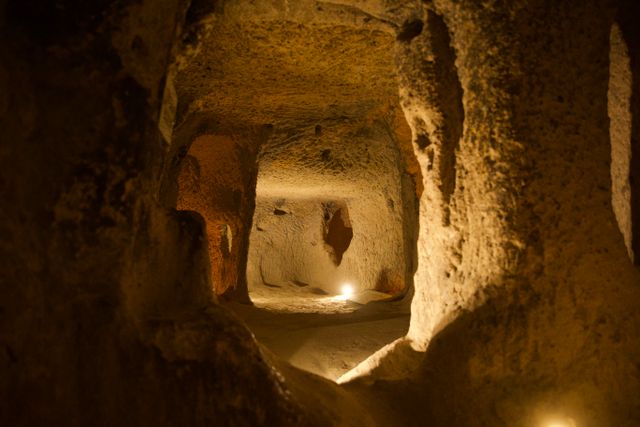
Among all the natural, historical and man-made places of interest in Cappadocia, the underground cities are without a doubt the most popular sites among travellers.
There are 36 underground cities in the region but I believe that many more are waiting to be discovered. How long it took them to complete, how many people worked to hollow them out, how these magnificent places were ever built and how they removed the debris and disposed of are still unknown.
Table of Contents
Although there is no task that man’s ingenuity and labour can’t overcome, it must’ve been very difficult given the technology at the time.
The most logical method is that, first, they hollowed out the air shafts of 75-80 m in depth going all the way down to the underground water, then they added chambers and tunnels to the sides of these shafts. And they took out the debris by means of these air shafts using pulley wheels. If the air shafts hadn’t been opened up first, they couldn’t have worked comfortably due to the lack of air, and these magnificent places couldn’t have been built.
Two questions come to mind when talking about the construction of the underground cities:
Where Did They Dump The Debris?
How did they eliminate it?
The debris from an underground settlement of 70-85 m in depth and covering an area of 4 km square should’ve formed a large hill.
One possible answer is that they dumped the debris into the river beds in the area that’s full of valleys and it disappeared in time with erosion.
The surroundings of Derinkuyu is rather flat. However, there is a river bed in the Kaymakli-Derinkuyu direction. This river is about 50-60m wide and 8 km long and is completely filled up now. I believe they dumped some debris into this river and some to the skirts of the Sogdele hill to the west. If they had been dumped the debris somewhere else, it would’ve formed a large hill. If they had spread the debris over the surrounding area, then the area would be arid not able to produce any crops. However, the surrounding area is very fertile.
Read Full Cappadocia Travel Guide here
Actually it wouldn’t have been difficult to hollow out the underground settlement city from the volcanic tufa and lava from the Erciyes and Hasan mountains. Most of the underground cities were built in places with volcanic tufa, which is quite soft and hardens with time through contact with air.
It wouldn’t have been possible to construct the underground cities with the techniques at the time if the ground hadn’t been soft.
On close inspection, it’s possible to see the differences between the upper and the lower floors of these cities.The upper floors and some air shafts are harder and were made hastily and bear no chisel marks whereas the lower floors and some other air shafts are softer, can still be carved easily in places and still bear chisel marks.
However, the carved places don’t harden in a short period of time and the marks are still visible. It takes a rather long time especially for the chisel marks to disappear. All these prove that there was a big time ditference between when the upper floors and the lower floors were built.
In 1910, the Englishman R. Campbell Thomson found some stone objects and a hand axe from the Paleolithic period in the Soganli river, 26 km from Derinkuyu. It’s still unknown if the upper floors of these underground cities in this area date back to the Paleolithic period as no archeological excavations have taken place in the area. However, the presence of the church with a cross plan at the 7th floor and the addition of the missionary school and the baptism pool to the upper floors of the Derinkuyu underground city provide tangible evidence that the Romans and the Byzantines lived here.
They built the system of air circulation in such a way that fresh air can easily circulate even in the lower floors of the underground cities. Derinkuyu underground city’s been restored to provide a good example of how the air circulation system works. As you get closer to the air shaft on the 7th floor, you can feel the air draft going up the shaft.
Temperature
The temperature in these places is about 7-8 C degrees throughout the year. It goes up to 13-15C degrees in places away from the shaft.
Another interesting texture with the underground cities are the holes with the ceilings of the first level, about 10 cm in diameter and 3-4 m in length. It’s believed that these holes were for communication and they hollowed them out using wooden drills with metal heads. In some places there’s only a single hole and in other places there are two side-by-side.
Today only some portions of the underground cities are open to the public. We don’t know much about these underground cities and we constantly come across questions about them.
It seems the more we learn about the civilisation, the more questions to ask.
Kitchens and Toilets
We see very few kitchens in these underground cities that we can visit. One would think that each family or every two families must’ve had a kitchen. However, we understand that many families used one communal kitchen in order to use as little fire as possible, as any smoke would easily identify the location of the underground shelter.
Although there’re some holes found in these underground cities, it isn’t known if they were toilets. Only in the underground cities of Tatlarin and Gelveri we found proper toilets. And they were made rather regularly and possible to use even today. The underground cities of Tatlarin and Gelveri are on the hill slopes and the toilets don’t have a septic pit. These underground cities belong to the Byzantine period.
On top of some of the underground cities are villages. Some of them have nothing above, not even the foundation stones.
How did people solve the problem of toilet facilities in flat areas?
The most reasonable explanation is that at normal times they could go out. But in times of danger when people couldn’t leave their shelters, they would use pots and jars, and seal their mouths to stop the odour and spread of diseases. And they would take out these jars when it was safe again to leave the underground cities.
During the restoration of the underground settlements now open to the public, there was no clothing items found. It is quite cool in the underground cities so they must’ve had different type of clothing. One could postulate that they used garments of animal skins when they stayed down there.
What was The Size of People?
Another question is, how tall were these people? The height of the tunnels in all the underground cities is between 160-170 cm. It’s thought that the ancient people of Cappadocia were actually taller than the people today. Whether this was true for the inhabitants of the underground cities is unknown.
The Wine
It’s apparent that, during the times when the people used underground settlements, wine and animals were of great importance as there are many wineries and stables on the upper floors of all the underground cities. These people farmed the land surrounding Derinkuyu as far as the skirts of the nearby hills. It is quite a distance from the entrance to the underground city.
Read more about what to do, the best activities in Cappadocia…
The Protection
How did these people protect themselves during the attacks and receive warnings of danger?
In the Cappadocia region, there are numerous small mountains and hills like Erdag, Cagni, and Kahveci. We understand that there were watch towers on top of these mountains but only some foundation stones have made it to the present day. It appears that they sent signals among these towers by reflecting sunlight with mirrors.
These underground cities played an important role in the spread of Christianity as shown by the number of churches and secret places of worship that have been uncovered during the excavations. It’s obvious that the underground cities weren’t in use after the 8th C AD.
The underground cities weren’t used for centuries thus eventually they filled in with stones brought by the snow and rain water through the doors and windows. They were partially closed in some places and completely blocked in others. For this reason, sometimes villages happened to establish above the underground city without knowing what was underneath.
One of the most interesting features of the underground cities are the millstone doors. Each door is approximately 50-55 cm in width, 170-175 cm in height and 300-500 kg in weight. The rock of the millstone doors differs significantly from that of the underground cities. So it appears that the people carved these millstone doors outside the undergroundcities and brought down here.
Most of the underground cities are on the eastern, southern and western sides of the hills. They weren’t on the northern sides as the winters in this region are very cold with a lot of snow.
No one knows who were the first people to build these underground cities, when they first started to build, where these people came from or exactly what their purpose was.
What are Cappadocia’s underground cities?
Cappadocia’s underground cities are extensive networks of tunnels, rooms, storage areas, and communal spaces carved into the soft volcanic rock.
Which are the most famous underground cities in Cappadocia?
Derinkuyu and Kaymakli are the two most famous and frequently visited underground cities in Cappadocia.
Why were the underground cities built?
They were built mainly as places of shelter and survival, allowing communities to protect themselves during raids, conflicts, and periods of instability.
How deep is Derinkuyu underground city?
Derinkuyu extends multiple levels underground and contains rooms, ventilation shafts, storage areas, kitchens, wells, and communal spaces.
How did people get air underground?
Large ventilation shafts were designed to circulate air through the different levels of the underground settlements.
Did people live permanently in Cappadocia’s underground cities?
The underground cities were primarily designed for shelter and survival rather than comfortable permanent living, although communities could remain underground for extended periods.
Can you visit Cappadocia’s underground cities?
Yes, visitors can explore parts of major underground cities such as Derinkuyu and Kaymakli, although some passages are narrow and require bending or crouching.