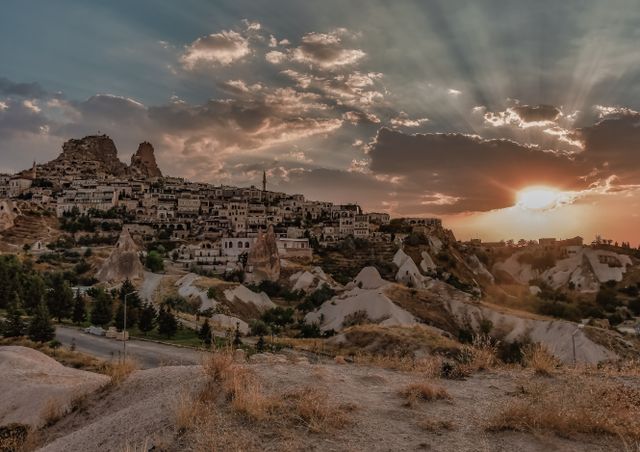
Million of years ago, lava from the volcanoes of Erciyas to the East and Hasan to the west covered the region and formed what we call as Cappadocia today. The history of Cappadocia begins with the arrival of man after the lava had cooled more than 10,000 years ago.
Table of Contents
Mingling with the people of Nesa in the area, the Proto-Hittites founded the strong Hittite Kingdom. They made Hattusa their capital and their kingdom lasted until BC 1200. The most extensive information about the Hittite civilization was obtained from the written sources found at the excavations at Hattusa and Kanish of Kayseri. In BC 1200 coming to Anatolia invaders repeatedly sacked, burnt and eventually eliminated the Hittite Kingdom. The traces of those conflagrations can still be seen at Bogazkoy, Alacahoyuk and Alisar. After the destruction of the Hittite Kingdom, many small states were formed and Anatolia was not centrally controlled for hundreds of years. The Phrygians were famous for horse raising.
Katpatuka
Unfortunately we dont’ know where the Phrygians originally came from, in which areas they first settled or how they managed to form such a powerful kingdom. We do know that they came to Anatolia across the Bosphorus and, according to Herodotus, they were called ‘Brygs’ or ‘Birgs’ in Europe.
After the Phrygians, Cappadocia fell under the control of the Medes for a short period of time. With the sudden collapse of the Mede Empire in the mid-6th C BC, the whole of Anatolia came under Persian rule in BC 547, The Persian Empire was divided into states administered by governors called “satraps”. There were more than 20 satrapies during the Persian period. They were part of a larger kingdom and paid their annual taxes with gold, silver talents or horses, and “Katpatuka” meant ‘the Land of Beautiful Horses’ in Persian.
Alexander the Great’s Role in History of Cappadocia
BC 333, Alexander the Great occupied the southern part of Cappadocia and after appointing a Persian named Sabiktasas, he continued south on his great campaign to conquer India. About a year later, Ariarethes I, loved and supported by the locals, became the King of Cappadocia. Although he extended the borders of his Kingdom to the Black Sea in the north and to the Euphrates in the east, Perdiccas, one of Alexander’s stepsons, marched into Cappadocia and seized control.
Full Travel Guide for History of Cappadocia
After Alexander’s sudden death with no heir, his empire began to weaken. Struggles for power amongst his generals, known as Diadochi, continued for about 300 years. Eventually the Romans brought an end to the last Hellenistic kingdom in BC 30.
In BC 47, Caesar’s army at war with the Pontus Kingdom, conquered the southern Pontus region, including Cappadocia. The Roman army later settled in Mazaka and its name was changed to Caesarea. The area became a Roman state in BC 17.
Jesus was thirty when he began teaching the word of God in Palestine and was later crucified upon the accusations of Pontius Pilate, the Roman governor of Jerusalem, who claimed Jesus would find a new state in Palestine. Soon after his death Jesus’ disciples left Palestine to spread the lessons of Christianity in different regions.
Christianity Developed in Central Anatolia
And great importance was placed on the building of churches and monasteries in history of Cappadocia.
This might be attributed to the influence of Gregory of Naziansus, Gregory of Nyssa and St Basil the Great, three important theologians of the time, all native to Cappadocia. The early places of worship were usually small monastic retreats. These weren’t architecturally significant buildings but modest places of worship generally built in the valleys, near the river beds or in places difficult to access as Christianity was still not freely practiced.
In 310 in the midst of civil turmoil and rebellion within the Roman Empire, Constantine was made Emperor of the Eastern Roman Empire. In 313, he liberated Christianity and named Byzantium (now Istanbul) the new capital of the empire. Under his reign Christianity was tolerated and it spread rapidly and developed with the construction of many churches, monasteries and hermitages.
Patriarchate of Constantinople(Istanbul)
Cappadocia and its places of Christian worship fell under the influence of the Patriarchate of Constantinople.
The 7th C saw important events both in the Byzantine (Eastern Roman)Empire and abroad. In Arabia a new religion, Islam, was born and spread to the borders of Byzantine Empire. Mesleme, a commander of one of Caliph Omer armies, brought his army as far west as Kayseri to defeat the Byzantines in 717 and 718.
Within the empire, the developing tendency of monks to worship icons to the degree of idolatry was seen as heretical. With the law passed by Leo IV in 726, the Iconoclast Period began and the power of the church over society diminished.
During this period in history of Cappadocia, religious depictions were forbidden and many churches and monasteries were abandoned. The Iconoclastic Period continued until 843 when Empress Theodora once again liberated icons.
Following this, new churches were built in the valleys of Goreme, lhlara and Soganli. The interior of these churches were beautifully decorated with frescoes showing scenes from the Bible. The most beautiful churches and frescoes of the Byzantine era date back to this period. The building of churches continued until the 13th C the beginning of Ottoman rule.
Under the control of the Seljuk Turks who took control of Anatolia in 1071, the religious beliefs and practices of the Byzantines weren’t restricted. Churches and mosques were often built in the same town exemplifying the religious and cultural tolerance that pervaded this period. A good example of this can be seen in Zelve valley.
How Many Churches Are There in Cappadocia?
Although it is not possible to give an exact number of churches, chapels and hermitages built in Cappadocia due to their abundance, 400 would be a reasonable guess.
In early Christianity, simple caves were often hollowed out to serve as private places of worship. Most of the surviving frescoes and decorations found in the churches of Cappadocia were made after the Iconoclasm. They are either in the classical style with beautiful, detailed drawings or simply depict the subject. Many are built with the same architectural lay-out. Great importance was given to the exterior as well as the interior of the building.
Throughout the history of Cappadocia the caves had been used as shelters from invading armies for eons and later were used as places of secret worship. However with the invasion of the Seljuk Turks in 1071 and their tolerance for Christianity, these underground caves and hidden places of worship lost their importance.
After the collapse of the Seljuks, the period of small states started in Anatolia and the fate of Cappadocian towns was thrown to the winds, becoming a part of different states at different times. One of those states, the Ottomans, grew to control the whole of Anatolia. Although Christianity was tolerated during the Ottoman Period, there was no significant religious development.
What Happened To The Christian community in History of Cappadocia?
The Christian community in Cappadocia effectively came to an end with the population exchange between Turkey and Greece after the establishment of the Turkish Republic in 1923.
History, nature and mankind have created many important wonders in Cappadocia:
1- The unique natural landscape, including fairy chimneys, rock formations and valleys.
2- The rock-hewn churches decorated with frescoes from the 6th – 12th C of scenes from Bible, especially the lives of Jesus, Mother Mary and saints.
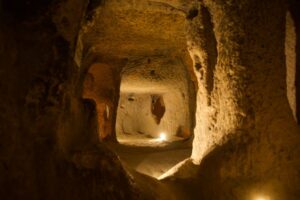
3- The underground settlements many consider to be the 8th wonder of the ancient world. They are believed to date back to long before Christ and were later used as secret places of worship and shelters.