15 Best Historical Sites in Istanbul You Must Visit
The experience of walking around Istanbul is like taking a steps into the past and seeing the richness of its history. The historical sites in Istanbul to visit include the majestic courtyards of the Ottoman palaces, Roman catedrals with their beautiful architecture, underground cisterns, and other buildings that speak about the history of Roman, Byzantine, and Ottoman civilisations.
Even if you have only one day to tour these historical places in Istanbul, you will be able to understand their importance at first glance.
Read my Istanbul Travel Guide article for more detailed information.
15 Most Popular Historical Sites in Istanbul
Table of Contents
1. Blue mosque (Sultan Ahmed Mosque)
For its fantastic interior design with 24.000 blue Iznik tiles, Sultanahmet Mosque has a reputation as a Blue Mosque all around the world. Blue mosque is an excellent example of Turkish-Islamic architecture, which brought an extra point of view to Ottoman mosque design. The mosque was completed in 1616 by the order of Sultan Ahmed I.
The Architect is Sedefkar Mehmet Aga, a student of Sinan the Architect from Suleiman the Magnificent’s era. Sultan himself worked in construction. Sultanahmet mosque is the first and only 6 minaret mosque in Ottoman origin. Sultan was highly criticized for building the exact same number of minarets with Makkah Mosque, thus he sponsored another minaret in there to solve the problem. Mosque is a vast complex with its bazaar behind, a madrasah, kitchen, royal tombs and more.
The Blue Mosque was included in the UNESCO World Heritage Site list in 1985 under the name of “Historic Areas of Istanbul“.
2. Topkapi Palace
Following Ottoman Sultan Mehmed II’s conquest of Constantinople in 1453, construction of the palace started in 1460 and completed in 1478. The palace is in the Historical Peninsula between the Marmara Sea, the Bosphorus and the Golden Horn.
The palace was the administrative center of the Ottoman Empire for 400 years. It was the resident of 30 sultans. It became a museum in 1924 with the establishment of the Republic. It’s one of the leading palace-museums in the world with its architectural structures, collections, special items of sultans, sacred relics, archival documents and the famous 86 carats Diamond of Spoons.
The Topkapi Palace was included in the UNESCO World Heritage Site list in 1985 under the name of “Historic Areas of Istanbul“.
3. Hagia Sophia
Hagia Sophia, which has a significant role in the history of architecture for its size and design, is one of the must-see museums in the city. Hagia Sophia, which is one of the most important monuments that survived until today, makes up an important place in terms of functionality in the art world.
It is the biggest church built by Roman Empire(or Byzantine Empire). Constructed 3 times in the same location, the first church had the name Megale Ekklesia, which means Big Church. From the 5th century and more it was called Hagia Sophia “Holy Wisdom”. Hagia Sophia is an important building, where the Roman Emperors’ coronations took place throughout the Eastern Roman Empire history. And it served as the main cathedral, the capital’s largest church.
Emperor Justinian sent orders to all states in his empire to get the most beautiful architectural pieces collected in order to have a more magnificent and flamboyant church. Therefore, the marble and columns used in the structure were brought from Syria, Aspendos, Ephesus, Baalbek, Tarsus.
Hagia Sophia was converted into a mosque after Ottoman conquest, and it was opened as a museum in 1935 by the will of Mustafa Kemal Ataturk. It was reconverted into a mosque in 2020 and reconverted as a half museum – half mosque combination in 2024 by Turkish Republic.
The Hagia Sophia was included in the UNESCO World Heritage Site list in 1985 under the name of “Historic Areas of Istanbul“.
4. Kariye Mosque (Chora Church)
Chora was a church structure dedicated to Jesus. Building was named Chora, meaning “rural area” or “extra-urban”, because of its location outside of Constantinople city walls.
The exact construction date of the building is unknown. But according to the narration of the writer Saint Symeon Metaphrastes from late 10th century, the relics of St. Babylas, martyred with his 84 disciples in Nicomedia (Izmit), were buried here in the beginning of the 4th century. It is obvious that the region of Kariye(Khora) Monastery started to gain importance as a sacred cemetery area (necropolis).
In Chora Monastery, today’s Chora Museum and Mosque, we can see the best examples of mosaic and fresco style decoration techniques together commonly used in Eastern Roman religious painting art. Outhern narthex exhibits Life of Jesus Christ and his miracles and inner narthex is decorated with mosaics depicting Virgin Mary’s life. Parekklesion has frescoes of religious stories from Old Testament such as Judgment Day (Deisis), Resurrection (Anastasis).
The building had no damage during the conquest of Istanbul and remained as a church until 1511, a mosque until 1945 and a museum until 2020. After its restoration, it was reopened as half museum-half mosque in 2024.
This monumental museum is one of the most remarkable historical sites in Istanbul, hosting some of the finest examples of Eastern Roman art. Its impressive architecture, magnificent mosaics, and beautifully preserved frescoes make it an important stop for anyone exploring Istanbul’s Byzantine heritage.
The Kariye (Chora) was included in the UNESCO World Heritage Site list in 1985 under the name of “Historic Areas of Istanbul“.
5. Dolmabahce Palace
Palace was built in 1853 by Sultan Abdulmecit in opulent European style for about 35 tons of gold cost. Once the palace was completed the royal family moved here from Topkapi Palace. Sultans decorated all the halls of the palace with presented furniture from all around the world. Highlight of the palace, Main Hall, is located higher, and it is one of the few halls in the world in terms of its size and height. The giant crystal chandelier with 750 lamps weighing 4.5 tons in the hall is a gift of Victoria, queen of the UK.
Dolmabahçe Palace holds the biggest collection of Baccarat & Bohemian chandeliers.
Ataturk, founder and first president of the Turkish Republic, occasionally stayed in the palace from 1927 until his death in 1938. Dolmabahçe hosted several governors such as Iran Shah, Lebanon, Irak, UK kings. The palace is open to visit as museum-palace since 1984.
6. Istanbul Archeology Museums
The Istanbul Archaeological Museums should definitely be on your list when visiting Istanbul, especially if you want to get a glimpse of the city’s early history. This museum complex is situated in Gulhane Park district near Topkapi Palace and includes a collection of items representing various civilizations like the Greeks, Romans, Egyptians, and Ottomans.
The main attractions in the museums are Alexander Sarcophagus and some ancient sculptures, and the convenient location of the museum allows it to be easily combined with other historical sites in Istanbul.
The Istanbul Archeology Museums was included in the UNESCO World Heritage Site list in 1985 under the name of “Historic Areas of Istanbul“.
7. Galata Tower
Here is a polished version with Historical Sites in Istanbul integrated naturally and without disrupting the flow:
Galata Tower
Galata Tower, one of the most recognisable landmarks and historical sites in Istanbul, was originally built in 528 by the Roman Emperor Anastasius as a lighthouse. The tower was damaged during the Fourth Crusade in 1204 and was later rebuilt by the Genoese in 1348 as part of the Galata fortifications. At that time, it was the tallest building in the town.
During the Ottoman period, Galata Tower was used for several purposes, including as a fire watchtower and a dungeon. Standing at 69.90 meters high, it remains one of the oldest and most distinctive towers in Istanbul.
Today, visitors can take an elevator to the observation level and enjoy impressive views across the Golden Horn and the Bosphorus. The panoramic view is one of the main reasons Galata Tower remains a popular stop when exploring the historical sites in Istanbul.
There is no longer a restaurant inside the tower. The restaurant was removed during the latest restoration, and the building now serves primarily as a viewpoint and historical attraction in the heart of Istanbul.
8. Basilica Cistern
It’s the biggest Roman cistern in the town. Usually people call it Underground Palace or Forest of Columns. Basilica Cistern was built on Stoa Basilica during Emperor Justian’s reign in 532. It has a hundred thousand cubic meters of water capacity to provide enough water for the royal palace and building around.
Ottomans used the cistern to water the plants, and it got forgotten by time until a traveller called Petrus Gyllius rediscovered it in 1546. 336 columns with 9m height carry the ceiling. 2 enormous Medusa heads are mysteries. There’s still water in it. With the ambiance in the cistern and especially the chill in hot summer days, it’s the most interesting spot in the old town to discover.
The Basilica Cistern was included in the UNESCO World Heritage Site list in 1985 under the name of “Historic Areas of Istanbul“.
9. Suleymaniye Mosque
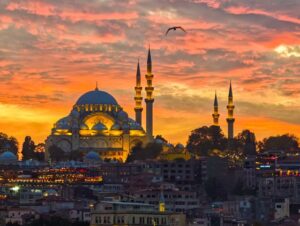
Suleymaniye Mosque was completed in 1557. Talented architect Sinan describes it as his “journeymen piece of work”. Courtyard has the best view of the city. Suleiman the Magnificent got Sinan the Architect to build this mosque on the third hill of Istanbul.
A huge complex building has 15 sections like schools, kitchen, hospital, watch house, etc. The complex building is such a compact town. Like the other works of Sinan, Süleymaniye Mosque is such a temple that transformed simplicity into magnificence. The decorations used in the inscriptions of the mosque are already aesthetic marvels of their own. You can’t find better acoustics anywhere else than inside the mosque.
The Suleymaniye Mosque was included in the UNESCO World Heritage Site list in 1985 under the name of “Historic Areas of Istanbul“.
10. Grand Bazaar
Grand Bazaar has been an important commercial center of Istanbul for over 500 years with its architecture, facilities, size and magnificence. Mehmed II ordered the construction in 1461 hence, we can accept this date for Grand bazaar history.
Here we are talking about a marketplace that is over 550 years old. Ottoman sultans intended to have a critical center for their capital of the big empire. Grand bazaar has a big role in the economy with its artisans and gold exchange. It has a total 45.000 square meter area and many gates to enter and exit.
There are various products in 97 different industry categories.Its like a complete city within hospitals, banks, restaurants, police stations and gold stocks. Even though street signs are set everywhere, there are many streets crossing each other, thus it’s hard to find whatever you’re looking for if you don’t know which way to go. In this case, it’s best to discover it with a professional guide who knows every corner without getting lost.
The Grand Bazaar was included in the UNESCO World Heritage Site list in 1985 under the name of “Historic Areas of Istanbul“.
11. Taksim Beyoglu
Taksim Square or Istiklal Street is a center of modern city. Both Taksim and Beyoglu formed as some of Istanbul’s most cosmopolitan neighborhoods due to their development since the 18th and 19th centuries by the arrival of the European merchant families, Levantines and their establishments.
These neighborhoods became famous by the Grande Rue de Pera, which became one of the central areas of commercial and social activities of Istanbul during the Ottoman period.
The first underground railway in the world was built in 1875 connecting Karakoy and Beyoglu, namely the Tunel funicular.
Since the 20th century, both Taksim Square and Beyoglu have become one of Istanbul’s significant public squares.
12. Egyptian Bazaar/ Spice Market
If you’re into authentic shopping you must visit Spice Market. Market was built by the mother of Sultan Mehmet II, Hatice Turhan Sultan in 1661. In the historical place, in which the herbalists and cotton producers operated in the first periods, products of different categories, from spices to sweets, from textiles to various essences are sold today.
13. Rumeli Castle
Mehmed II ordered the construction of a castle in 1452 to have full control over Bosphorus entrance from Black Sea. He achieved his goal and left us a beautiful touristic attraction for travellers to add to their bucket lists.
Castle also hosts many cultural and musical events in different periods of the year.
14. Maiden’s Tower
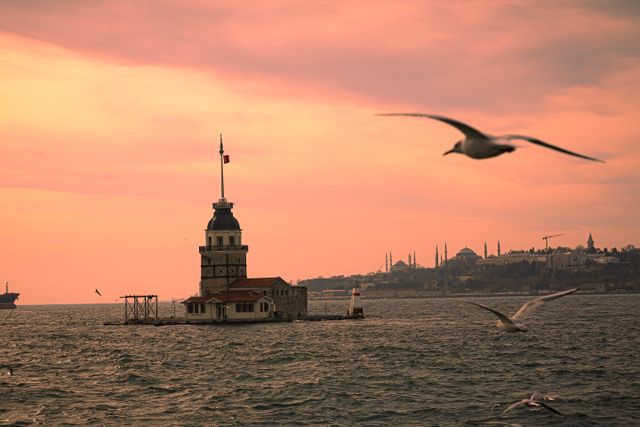
The Maiden’s Tower was built in 410 by the Athenian Alkibiades in order to provide control of the ships in the Bosphorus. Romans strengthened the building to support city defence.
With its tales told from generation to generation, Maiden Tower is one of the most romantic places in the city. The old restaurant inside was removed during the last restoration.Today its view around provides amazing time for visitors and enchant local and foreign tourists.
15. Prince Islands
Prince Islands are famous for their architecture, fish restaurants, ice cream shops, beach clubs. They have recently become one of the most preferred place for both weekend getaways and long-term holidays. Aya Yorgi Church and Greek Orphanage are the top places to visit in the largest of the Prince Islands.
1. What are the most important historical sites in Istanbul?
Some of the most important historical sites in Istanbul include Hagia Sophia, the Blue Mosque, Topkapi Palace, Basilica Cistern, Suleymaniye Mosque, Galata Tower, the Grand Bazaar, Kariye Mosque, Dolmabahce Palace, and the Istanbul Archaeological Museums. Together, they reflect the city’s Roman, Byzantine, Ottoman, and modern history.
2. What is the best area to visit historical sites in Istanbul?
The Sultanahmet area, also known as Istanbul’s Old City, is the best place to start. Hagia Sophia, the Blue Mosque, Topkapi Palace, and Basilica Cistern are all within walking distance of each other, making it possible to visit several major historical attractions in one day.
3. How many days do you need to see the historical sites in Istanbul?
You can see the major historical sites in Istanbul in about two to three days. One day can focus on Sultanahmet, another on areas such as Galata and Beyoglu, and a third can include Dolmabahce Palace, Suleymaniye Mosque, or a trip to the Prince Islands.
4. Is Hagia Sophia a mosque or a museum?
Hagia Sophia currently functions as a mosque, while designated areas also operate within a museum-style visitor experience. Its history includes several major changes in function, from Byzantine cathedral to Ottoman mosque, museum, and its current status. Visitors should check the latest visitor arrangements before planning their visit.
5. Which historical site in Istanbul is best for Ottoman history?
Topkapi Palace is one of the best places to explore Ottoman imperial history. It served as the administrative and residential center of the Ottoman sultans for centuries and contains important collections, architectural spaces, documents, and historical objects.
6. What is the oldest historical site to visit in Istanbul?
Istanbul has historical remains spanning many different periods, so there is no single simple answer to the question of the “oldest” site. The city contains Roman, Byzantine, and even earlier archaeological layers. The Istanbul Archaeological Museums are particularly useful for understanding these earlier civilizations and the long history of the region.
7. Can you visit the main historical sites in Istanbul without a guide?
Yes, you can visit many of Istanbul’s historical sites independently. However, a local guide can help explain details that are easy to miss, particularly at places such as Hagia Sophia, Topkapi Palace, the Basilica Cistern, and the Grand Bazaar, where the historical context is much richer than what you see at first glance.
8. What not to miss when visiting Istanbul’s Old City?
If you have limited time, focus on Hagia Sophia, the Blue Mosque, Topkapi Palace, and Basilica Cistern. These attractions are close to one another and give you a strong introduction to Istanbul’s Byzantine and Ottoman heritage.
9. What is the best historical site in Istanbul for architecture?
Istanbul has several outstanding architectural landmarks, and the answer depends on the period you are interested in. Hagia Sophia represents Byzantine architecture, the Blue Mosque and Suleymaniye Mosque showcase Ottoman religious architecture, while Dolmabahce Palace demonstrates the European influence on late Ottoman architecture.
10. What historical sites in Istanbul do tourists often overlook?
The Istanbul Archaeological Museums, Suleymaniye Mosque, Kariye Mosque, and parts of the Grand Bazaar can receive less attention than Hagia Sophia and the Blue Mosque. These places offer a different perspective on Istanbul’s history and can be especially rewarding if you want to go beyond the city’s most photographed landmarks