Hagia Sophia: From Cathedral to Mosque
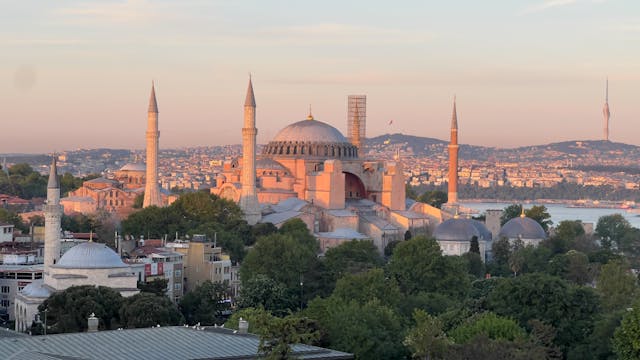
There are very few places in Istanbul where layers of history become apparent at once. Walking around the monument area, it becomes easy to understand how Constantinople was the center of the Eastern Roman world and, later, the Ottoman Empire.
Hagia Sophia was first built as a cathedral commissioned by Emperor Justinianus of Eastern Roman Empire after the Nika Riot of 532. Its construction took place between 532 and 537, an extremely short period for such a monument.
However, the monument is not only unique because of its dimensions. It has an interesting story that includes three churches on the same spot, Roman Christian relics, Ottoman additions, impressive mosaics, earthquakes and architectural solutions to preserve the building for centuries to come.
Table of Contents
The Three Hagia Sophia Churches on the Same Spot
The building that visitors currently see was actually built third and, therefore, is also called the third Hagia Sophia.
The first two churches were destroyed during riots. The second church is of particular interest since it supposedly hosted the second Ecumenical Council and the first Istanbul Council. It suffered a dramatic fate during the Nika Riot in 532.
Following the riots suppression, Justinianus decided not just to reconstruct the old church but create something bigger and more magnificent.
Some ruins of the previous church are preserved in the garden of the building. Remains, porticos, columns, and capitals are visible as the proof that the monumental building that stands today isn’t the first church built there.
The second church was built two meters under today’s ground, so visitors can say that the building’s history is literally layered underneath the current building.
Justinianus and the Construction of the Great Hagia Sophia Church
Construction of Hagia Sophia started in 532, right after the Nika Riot. Justinianus hired two well-known architects of that time, Isidorus of Miletus and Anthemius of Tralles.
Hagia Sophia construction was finished in 537.
Five years is a rather amazing speed when thinking about the scale of the project. About 10,000 people were involved in its construction and, for Justinianus, it became a really expensive project to implement.
While opening the construction with the grand ceremony, Justinianus reportedly began his speech with the phrase, “Solomon, O Solomon, I beat you!” It was meant to refer to his church being larger than the Temple of Solomon, which was considered the biggest construction before that time.
The name of the monument is also significant in its religious context. Sophia is a Greek word for wisdom, so the full name of the monument ”Hagia Sophia” means Holy Wisdom and refers to one of the three attributes of God in Orthodoxy.
An Unusual Architectural Design
The architecture of the building is one of the most unusual characteristics of Hagia Sophia.
The building combines basilical and domical planning. Its main dome looks like it dominates the whole building due to supporting elements.
Such a system starts with the main dome and its half domes, and ends with smaller half-domed exedras. Thus, a whole hierarchy of gradually decreasing in size curved spaces was created.
Such a combination of half domes, arches, and vaults made an extremely complex structural system unseen in any other antique building.
The dome itself is big enough to make all the supporting structures appear as the part of the whole architectural space rather than separate elements.
The building was made of mortar, not brick.
Moreover, the scale of the building was unusual in that period of time. Any other basilica couldn’t achieve such a great size before the sixth century while this building successfully united the huge internal space with a complicated dome system.
The Materials That Came From Different Parts of the Ancient World
Construction of such a monumental building required lots of materials from many different regions.
Red porphyry from Egypt, green porphyry from Greece, white marble from Marmara, yellow stone from Syria and black stone originally from Istanbul were used for veneers and columns.
Some columns, doors, and stones were transferred from old temples and sanctuaries.
Some of the sources of such materials are the Artemission in Ephesus, Heliopolis Sun Temple in Egypt and Baalbek Temple in Lebanon.
Transportation of such large and heavy materials from distant regions is one of the most impressive details for many people when studying the construction process.
This explains why the building has so many stones in its interior. Their colors and textures tell about how the building was constructed.
The Christian Relics of Constantinople
For many centuries, the building remained the center of the Christian world of Constantinople.
Since the church was the seat of the Patriarch of Constantinople, it had a big collection of relics related to Christianity.
The relics included such things as Jesus’ cross and crystal pot with his blood.
These relics were the part of the religious significance of the monument. It wasn’t only a large architectural space but also a major religious center with objects of worship.
What Happened after the Ottoman Conquest?
In 1453, Constantinople was conquered by the Ottomans and Sultan Mehmed II turned the church into a mosque.
The name of the monument didn’t change. Even being the mosque for almost five centuries, the building kept its original name.
At the same time, a new layer of architecture was added to the building.
Four minarets were added around the main structure by Ottoman sultans. They were not just decoration but also big blocks of stone that pushed the building in all four directions.
This is a very important point about the survival of the building.
When the Ottomans captured Constantinople and turned the church into the mosque, the monument was in very bad condition and was described as being near collapse. Sinan the Architect added retaining walls, so the building wouldn’t suffer from further structural damage.
For everyone interested in architecture, this is one of the most important things to keep in mind when looking at the monument – it’s the result of several constructions, repairs, adaptations and preservations.
How Mosaics Were Saved
Mosaics are the most visually impressive element of the building.
After the conversion into a mosque, the mosaics depicting faces were left intact. Also, the mosaics without faces weren’t destroyed or damaged but, instead, were covered with plaster that protected them from natural and artificial damage.
This decision had a huge impact on future.
During Mustafa Kemal Ataturk’s reign when the building was turned into the museum, the plaster was removed. As a result, the mosaics were revealed again.
It means that now visitors can see evidence of the building’s Roman Christian past along with the Ottoman history.
Sinan and Ottoman Structural Solutions
Ottoman additions weren’t limited to four minarets around the building.
Sinan the Architect did a lot for preservation of the building, adding retaining walls. Such a structural solution was crucial for preservation of the enormous building given its size and history of earthquakes.
Thus, the building became a monument with Roman and Ottoman architectural solutions existing next to each other.
Inside the building, there were also such Ottoman additions as the Emperor’s Lodge, marble minbar, mihrab, fountain, library, two enormous marble jars, giant oil lamps, sermon area, second preacher gathering balcony, and large round tables.
The courtyard of the building also has tombs of Ottoman sultans.
The name of the building remained the same throughout the whole Ottoman period, despite the fact that it functioned as a mosque for almost five centuries.
The Current Status of the Building
The building was turned into the museum under Mustafa Kemal Ataturk so that its Roman Christian past and mosaics were accessible for visitors from all over the world.
The building was turned into the mosque in 2020 and it remained a mosque until today. 2024 it started to function as a ticketed museum on upper gallery for foreigners.
Also, it is called the oldest cathedral in the world and, for approximately 1,000 years, the largest one in the world, being surpassed by Seville Cathedral in 1520. In terms of acreage, it is the fourth largest building nowadays.
A Monument Built in Five Years and Remaining Intact for Centuries
The history of the building started with Justinianus and a huge construction project carried out between 532 and 537.
However, it continued with the religious life of Constantinople, Nika Riot, Ottoman conquest, conversion into a mosque, hundreds of years of Ottoman additions, structural solutions by Sinan the Architect, museum period under Mustafa Kemal Ataturk and its re-conversion into the mosque in 2020.
Its Roman Christian mosaics survived being under plaster. The Ottoman additions are visible. The previous church can be seen in the garden. Its enormous dome and structural system remain the same.
Book a guided walking tour to have a better understanding of history of Istanbul
1. What is Hagia Sophia? Hagia Sophia is a historic monument in Istanbul that has served as a church, mosque, museum, and mosque again. The present building was completed in 537 AD during the reign of the Byzantine Emperor Justinian I. It was the principal cathedral of Constantinople for centuries.
2. When was Hagia Sophia built? The present Hagia Sophia was completed in 537 AD. It was actually the third major church built on the same site. The earlier churches were destroyed before Justinian ordered the construction of the building that survives today.
3. Who built Hagia Sophia? Emperor Justinian I commissioned Hagia Sophia after the Nika Revolt destroyed much of the earlier church in 532. The architects Anthemius of Tralles and Isidore of Miletus designed the new building.
4. Why is Hagia Sophia called Hagia Sophia? The name Hagia Sophia comes from Greek Hagia Sophia, meaning “Holy Wisdom.” The name refers to Divine Wisdom rather than to a person named Sophia.
5. Was Hagia Sophia always a mosque? No. Hagia Sophia was originally built as a Christian cathedral. After the Ottoman conquest of Constantinople in 1453, Sultan Mehmed II converted it into a mosque. It became a museum in 1935 and was reconverted into a mosque in 2020.
6. Why is Hagia Sophia important? Hagia Sophia is important for its combination of Byzantine architecture, Christian mosaics, Ottoman additions and Islamic decoration. Its enormous dome was also a major architectural achievement for its period. It became one of the most influential buildings in Byzantine architectural history.
7. What happened to Hagia Sophia after the Ottoman conquest? After Constantinople was conquered in 1453, Hagia Sophia became an imperial Ottoman mosque. Ottoman sultans added elements such as minarets, a mihrab, a minbar and other Islamic architectural features. The building continued to function as a mosque for centuries.
8. Are the Christian mosaics in Hagia Sophia still visible? Yes. Several Byzantine mosaics survive inside Hagia Sophia. Some were covered or concealed during its centuries as a mosque and were revealed or restored during later conservation work. Their presence reflects the building’s earlier role as a Christian cathedral.
9. Is Hagia Sophia a museum or a mosque today? Hagia Sophia currently functions as a mosque. It was reopened for Muslim worship in 2020, while the historic building remains an important cultural and tourist attraction.
10. Where is Hagia Sophia located? Hagia Sophia is located in Sultanahmet, in Istanbul’s historic peninsula, close to the Blue Mosque, Topkapı Palace and the Basilica Cistern. Its location makes it easy to include in a walking itinerary through Istanbul’s major historic monuments.